GRAMMAR

Fehler-Atlas · Chinesisch-Sprecher (中文)

June 30, 2026
|25 Fehler · DE+ZH
Fehler-Atlas · Chinesisch-Sprecher (中文)
€9,99einmalig — Sofort-Download
Sichere Zahlung über Stripe · 14-Tage-Widerrufsrecht

Was bekommst du?

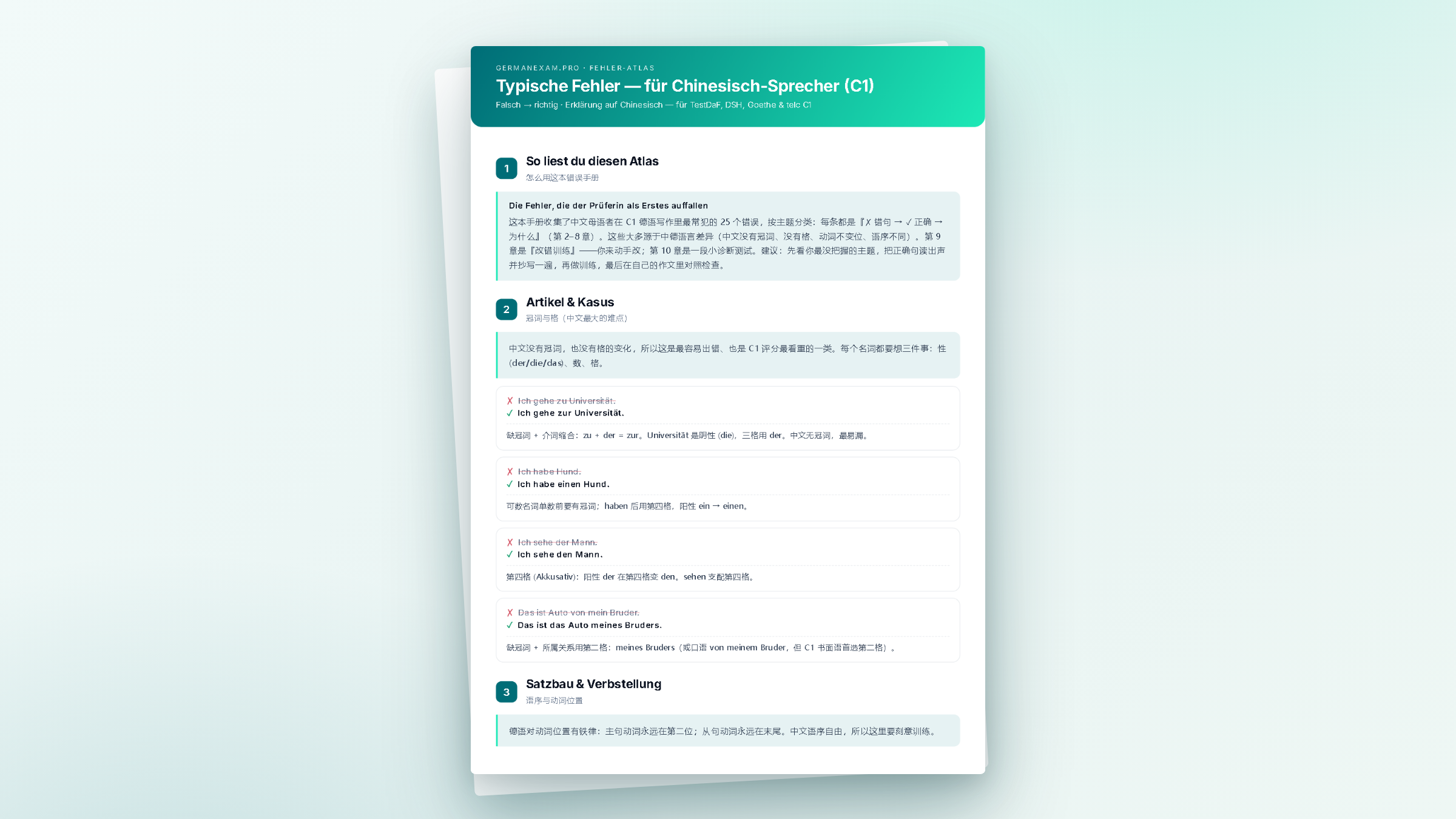
Ein zweisprachiger Fehler-Atlas: 25 typische Fehler chinesischer Lerner im C1-Deutsch, jeweils als ✗ falsch → ✓ richtig → warum — und das „warum" auf Chinesisch. Genau die Fehler, die einer Prüferin als Erstes ins Auge fallen. Erstellt von einer aktiven C1-Prüferin.

Inhalt im Überblick

  • Artikel & Kasus — der größte Stolperstein, weil es im Chinesischen beides nicht gibt
  • Satzbau & Verbstellung — Verb an zweiter Stelle, Verb am Ende im Nebensatz, Te-Ka-Mo-Lo
  • Perfekt: sein oder haben — und unregelmäßige Partizipien
  • Präpositionen & Kasus — feste Verbindungen wie „warten auf", Wechselpräpositionen
  • Adjektivendungen — die drei häufigsten Fehlerquellen
  • Verben mit festem Kasus & Reflexive — danken + Dativ, sich erinnern an …
  • Negation, Tempus & Wortwahl — kein vs. nicht, Zeitformen, falsche Wortwahl

Für wen?

Chinesische Muttersprachler:innen auf dem Weg zu C1, die ihre persönlichen Dauerfehler endlich abstellen wollen.

Format & Lieferung

PDF, zweisprachig (Deutsch + Chinesisch), 25 kommentierte Fehler in 7 Themen. Sofort-Download nach Kauf, unbegrenztes Re-Download im Mein-Konto-Bereich.

How many mistakes am I allowed to make in C1 writing?

There is no fixed error count. What is graded is whether the text stays consistently understandable and shows C1-level range. Systematic, recurring errors (articles, endings, sentence structure) pull down the accuracy criterion far more than an isolated slip.

Is it worth practising the typical mistakes of your own first language?

Yes. Patterns shaped by your first language occur systematically and therefore cost you repeatedly on the accuracy criterion. Clearing exactly those is what lifts the criterion that, at C1, often decides passing or failing.

How does the examiner spot B2 instead of C1?

By recurring signals: only short main clauses, everyday fillers, missing passive, little nominalisation. These patterns are often correct but not academic — and mainly pull down vocabulary/repertoire and expression. C1 shows itself in complex sentences, impersonal language and precise collocations.

Related Topics

fehler
grammatik
c1
testdaf
dsh
zweisprachig
chinesisch

Build a TestDaF text with the agent

Write a text on this topic — your Agent assesses it honestly, like the real exam, and practices with you until you pass.

Find out honestly if you'll pass

Write a text — your Agent assesses honestly like the real exam and practices with you until you pass. No account needed to start.